Fall School 2025: Generative Artificial Intelligence & Problem Solving in Physics
25-26 September 2025
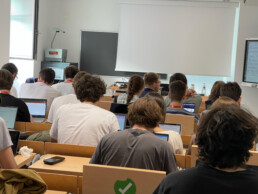
On 25–26 September 2025, the AI Society at the University of Padua organized the Fall School “Generative Artificial Intelligence – Problem Solving in Physics”, an intensive two-day educational initiative designed for students enrolled in the Bachelor’s Degree in Physics.
The Fall School represented the Society’s flagship training activity for physics students, combining theoretical lectures, hands-on workshops, guided exercises, and interactive discussions. The program introduced participants to the foundations of generative artificial intelligence and explored its practical use as a tool for scientific reasoning and problem solving.
Throughout the two days, students worked on topics including:
- The principles behind modern generative AI models;
- Effective prompting techniques for scientific applications;
- The use of AI systems to support physics problem solving;
- Comparative analysis of different large language models;
- Critical evaluation of AI-generated solutions;
- Methodological and epistemological limitations of generative AI.
A distinctive feature of the Fall School was its strong emphasis on experiential learning. Rather than simply introducing AI technologies, participants were encouraged to experiment directly with multiple AI models, compare their behavior, identify strengths and weaknesses, and reflect on when AI can effectively support scientific reasoning—and when human expertise remains essential.
Prior to the event, an open communication campaign introduced the initiative to the student community, presenting it as a pilot project aimed at developing advanced AI competencies that could later be extended to a broader audience within the University.
Participation was based on an open application process. The School was offered free of charge, required no prior experience with artificial intelligence, and was designed to be fully inclusive. Learning activities were adapted to participants with different backgrounds, and no personal software licenses or specialized hardware were required. At the end of the program, participants received a certificate of attendance recognizing the competencies acquired during the School.
The Fall School demonstrated how generative AI can become a valuable educational companion for physics students—not as a replacement for scientific thinking, but as a tool to enhance problem-solving skills, stimulate critical analysis, and promote a deeper understanding of physical concepts through active exploration.